 Back to the Index
It's a PC, you type DIR
— Cathode Ray Dude
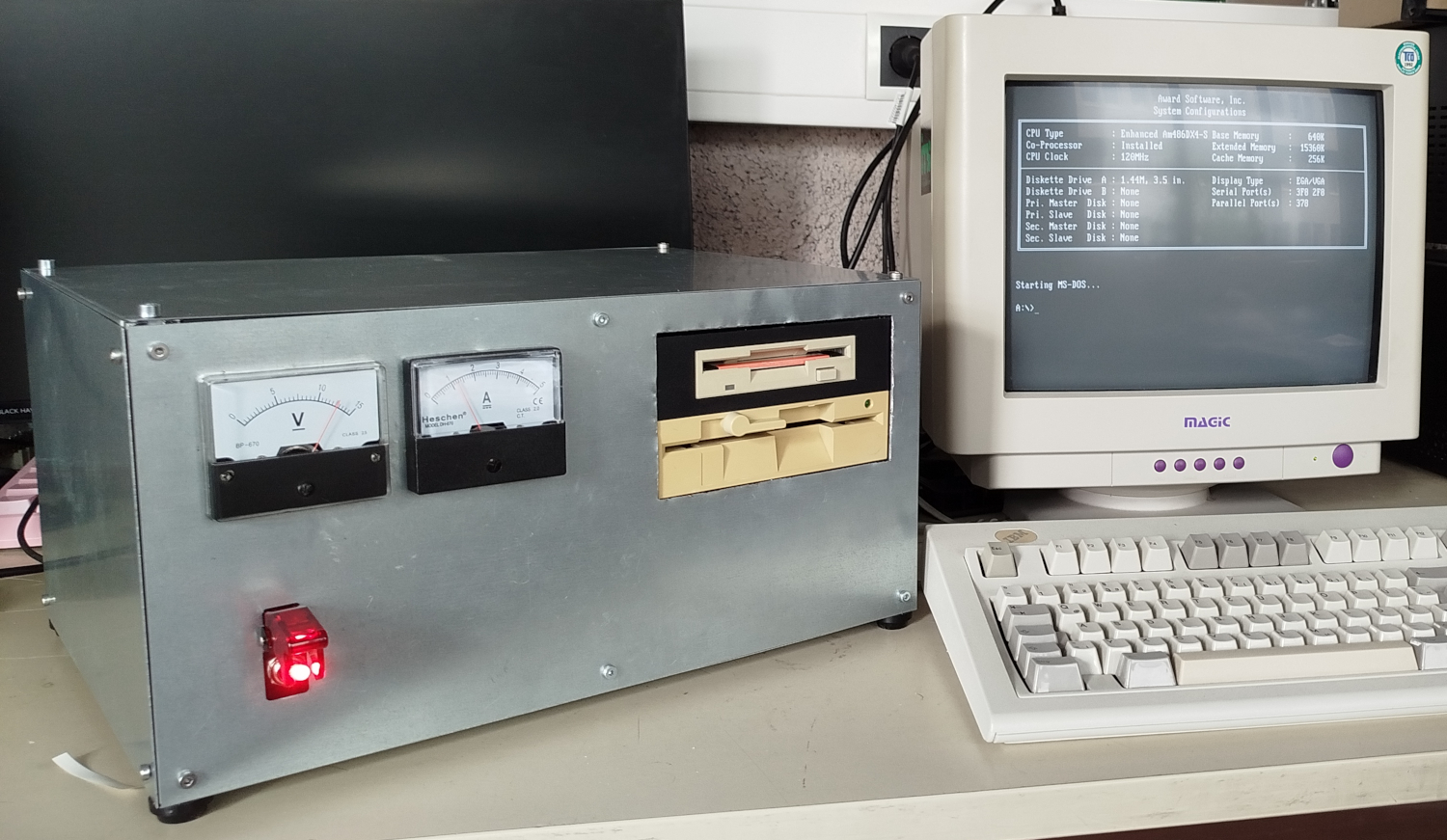
The thing you are looking at is a cuboid frame made of aluminium extrusions, 40x30x20cm in size, covered in sheet metal (galvanized steel, 0.6mm thick). It was built around a Zida 4DPS mainboard with an AMD Am486DX4 on it (the "enhanced" version, i.e. with writeback cache), running at a ludicrous 120MHz. It is equipped with 16M of RAM, about half what the mainboard supports.
The mainboard itself is from 1995, has both PCI & ISA slots, and with the CPU probably represents the tail end of the 486 era.
The graphics card currently installed in the machine is an S3 Virge/DX based PCI card from 1997. There was no particular reason for using that, I just happened to have a box of them that I bought for cheap at an EBay auction.
Status: Technically working, case mostly complete
TODO:

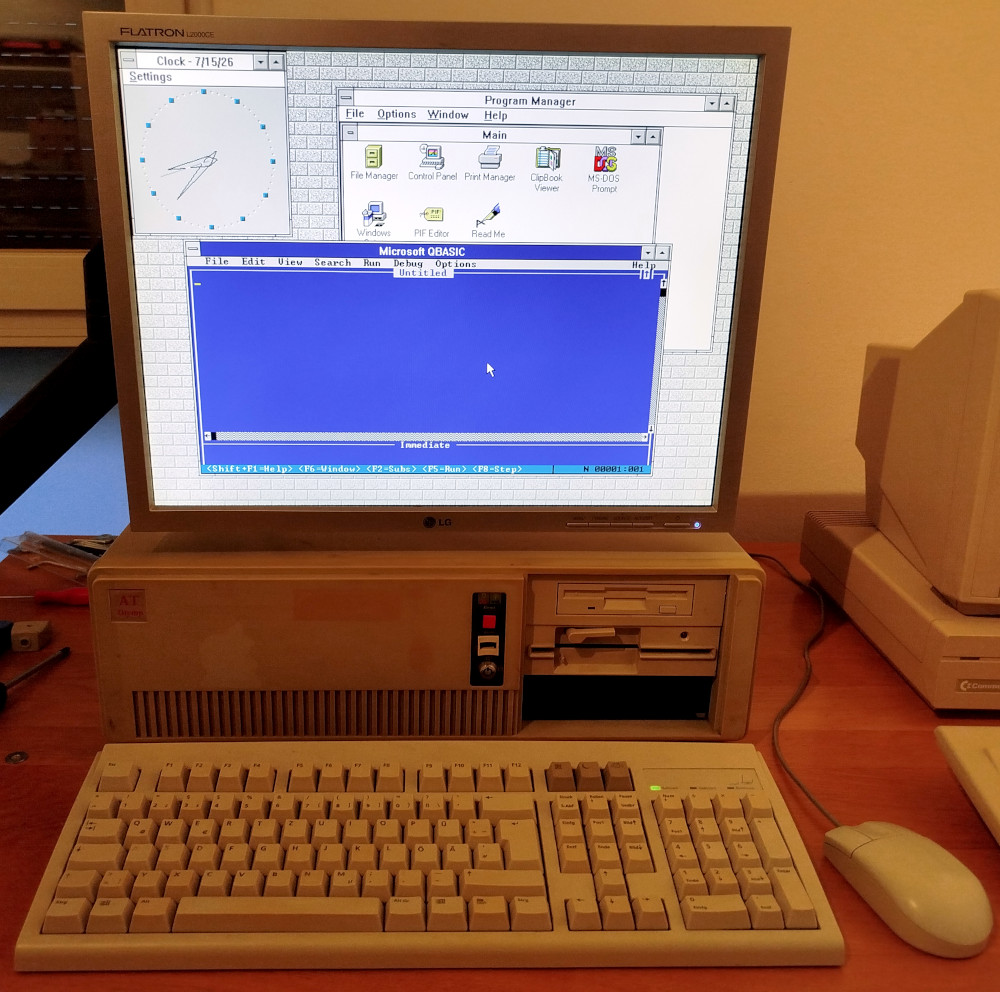
The picture above shows a PC-AT style clone case, the label says "AT Olymp". It is running Windows 3.11 in "enhanced mode" (i.e. in 32 bit mode). An old serial mouse and a trash picked PS/2 keyboard with an PS/2 to AT adapter are attached to the PC.
The screen is a 3rd or 4th hand 20" LG FLATRON L2000CE that I use for testing, attached via a vesa arm to the desk.
Side note: I have actually worked with MS Office 4.x on Windows 3.x way back when, on 286 and 368SX machines (Commodore PC30-III, some PS/2, I don't recall which model). It is very strange seeing the familiar UI on a modern LCD. Low resolution, crisp, sharp, blown up to ridiculous proportions because the LCD is humongous compared to a 12" or 15" CRT.
I originally got the machine from a friend whose parents wanted to toss it out. I ended up having to replace quite a number of the parts to restore it to working order. It originally would only boot sporadically until finally something near the cache card released magic smoke. The card itself has been suspected and now has vanished into the Aether of the hackerspace after someone decided to "repair" it.
A percussion cap had ejaculated inside the PSU. The machine used to have 3 hard drives installed, all broken. One was in a swappable frame I that removed, hence the gaping hole in the 3rd drive slot.
I swapped out the mainboard for a J-Bond A340C-H with an AM386DX, running at 40MHz, a bit faster than the 33MHz Intel 386DX on the original ECS 386S . The AMD CPU is a soldered on laptop variant, an Intel 387 was transplanted from the original mainboard.
The new mainboard has 8M of RAM and 128k of SRAM cache installed, similar to the old configuration. A 128M PQI DiskOnModule is installed that the machine boots from, using XT-IDE Universal BIOS on an EEPROM option ROM card , plugged into an 8 bit ISA slot.
Status: Technically working
TODO:
 A walk through the installed components, new and replaced
Installing a DiskOnModule and Windows 3.11
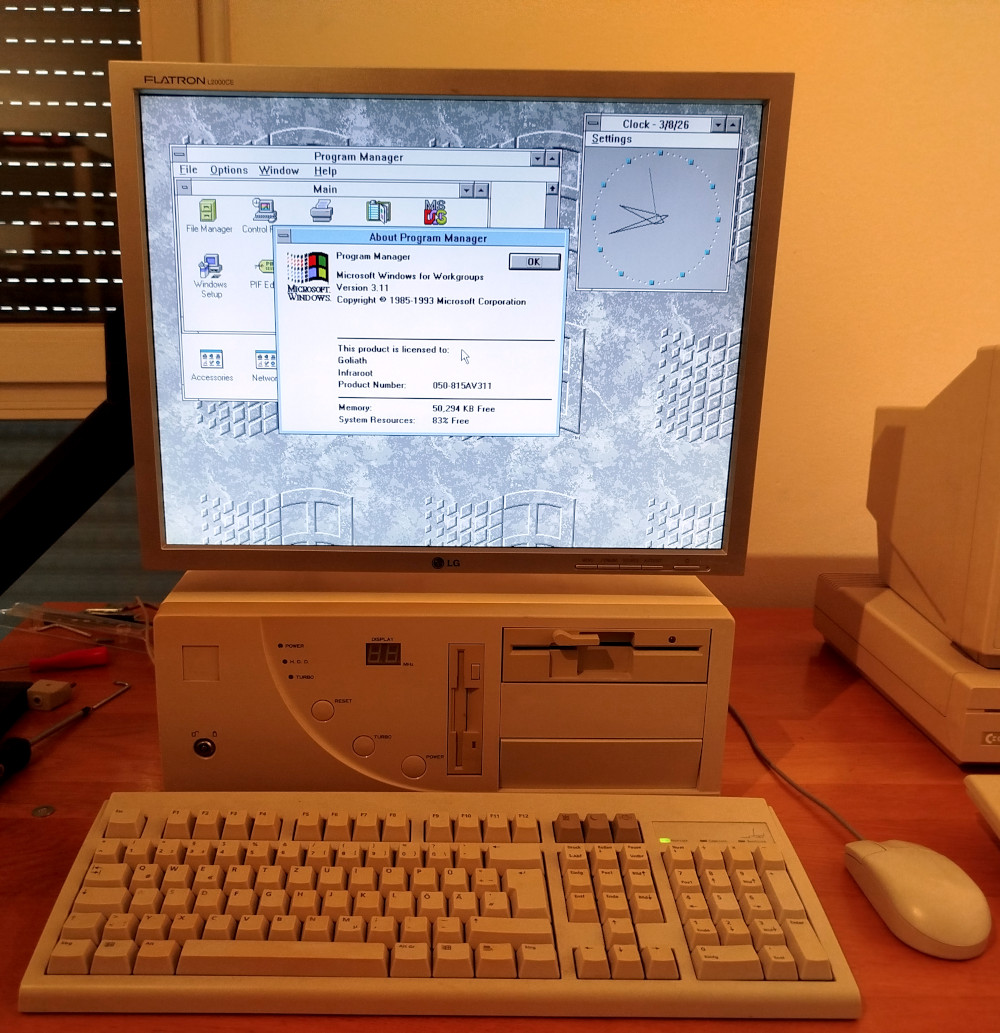
This is a PC that I assembled picemeal from individual components, either old stuff I had around, stuff scavanged from the local hackerspace, or EBay purchases (e.g. the PC-AT case).
The mainboard is a DataExpert OPTI-495SX with an Intel i486DX2, clocked at 66MHz. It currently has 16M RAM installed, I already had it at 32M for a while (maximum the board supports) but one of the RAM sticks developed a parity issue, so I (temporarily) had to pull the whole bank.
The graphics card is a Trident TVGA 9000C based 16 bit ISA card with 512k of memory on it. The mainboard theoretically has a VLB slot, but OPTI was apparently an early adopter of VLB and it is not quite compatible with the actual VESA specification.
The machine boots of a CF card, connected to the IDE slot of a 16 bit ISA super I/O board. To make this work, an option ROM card with an XT IDE ROM is installed in an 8 bit ISA slot. The card currently in use has Windows 3.11 (for workgroups) installed, the mouse I'm using is a Microsoft compatible serial mouse.
Both floppy drives have been cleaned, tested and work just fine. The 5.25" one is an 1.2M drive, but I've already used it to (successfully) copy files onto a 360k floppy for the Commodore PC-I.
Because of the piecemeal assembly, a number of OSHW components were used, particularly during initial testing:
Status: Working, but some issues to be ironed out
TODO:
Final version in a proper case
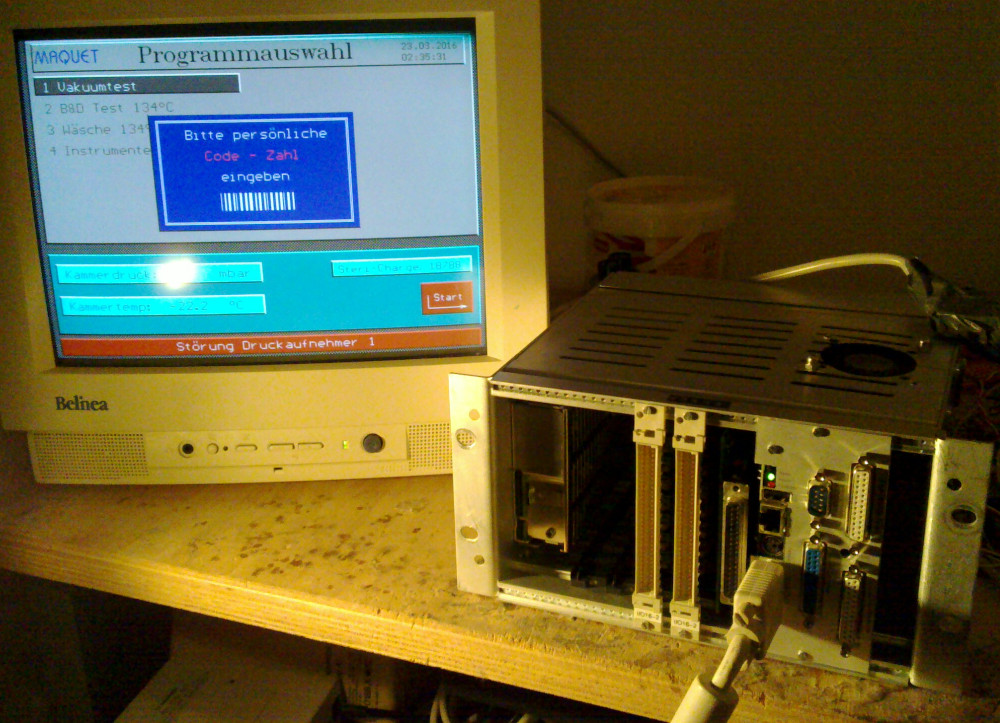
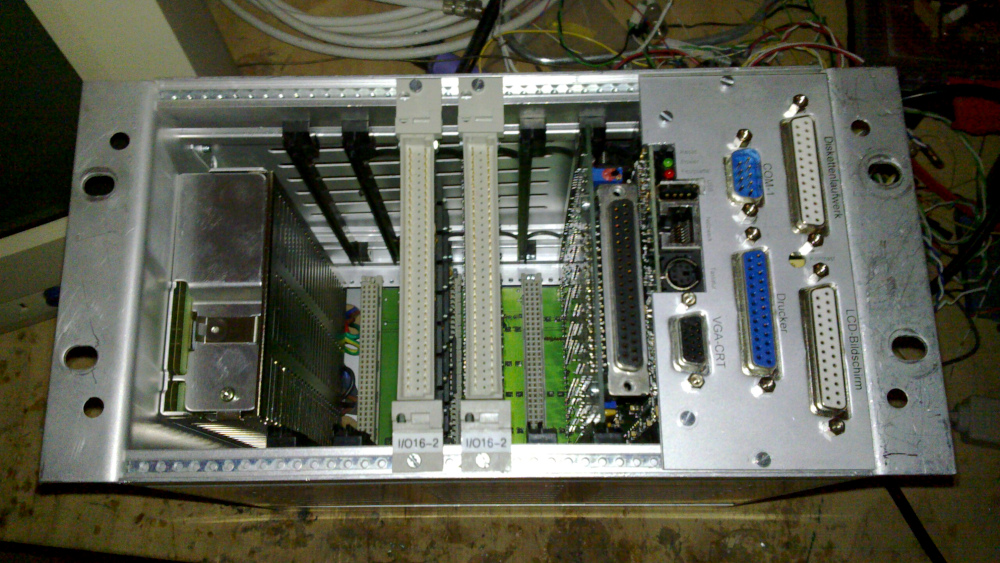
Back in 2016, someone in orbit around the local hackerspace showed up after work, announcing he was involved in demolition going on at a decomissioned hostpital wing. He said he found some "really cool machines" he thought we might be interested in, so he dismanteled them and brought some interesting parts over. After an an initial panic it turned out he had lugged a bunch of rack mount industrial PCs to the space.
It is not clear what machines those PCs had been part of. When started up, they boot into FreeDOS and fire up a German TUI program, displaying the logo of MAQUET, a medical company. The TUI program displays a bar code, asks for a "personal code" to be entered. In the background, there is some text about vacuum chamber pressure, temperature, sterilization, and of course a bunch of errors about faulty (i.e. missing) sensors.
The PC has a DIN41612 backplane with 100mm x 160mm Eurocard PCBs slotted into it. Possibly STEbus ? A power supply is mounted to the chassis, there is a single CPU card with an Geode GX 1 CPU on it, 64M RAM, a 40G laptop HDD, and 3 more I/O cards.
The Geode GX1 is based on a modified Cyrix MediaGX , a Pentium MMX compatible CPU. There were a lot of confusing mergers, acquisitions and IP sales at the end of the 90s as almost everyone who wasn't AMD or Intel stopped making x86 CPUs. The rights to the Cyrix designs were passed around a lot (which was already fabbed by other companies under their brands for legal reasons). National Semiconductor used the designs for their Geode line of embedded x86 CPUs. The designs were eventually acquired by AMD who continued the Geode product line. The GX1 in this PC predates the AMD acquisition.
Status: 1 unit working, rest dismanteled, module cards floating around the Hackerspace
TODO:
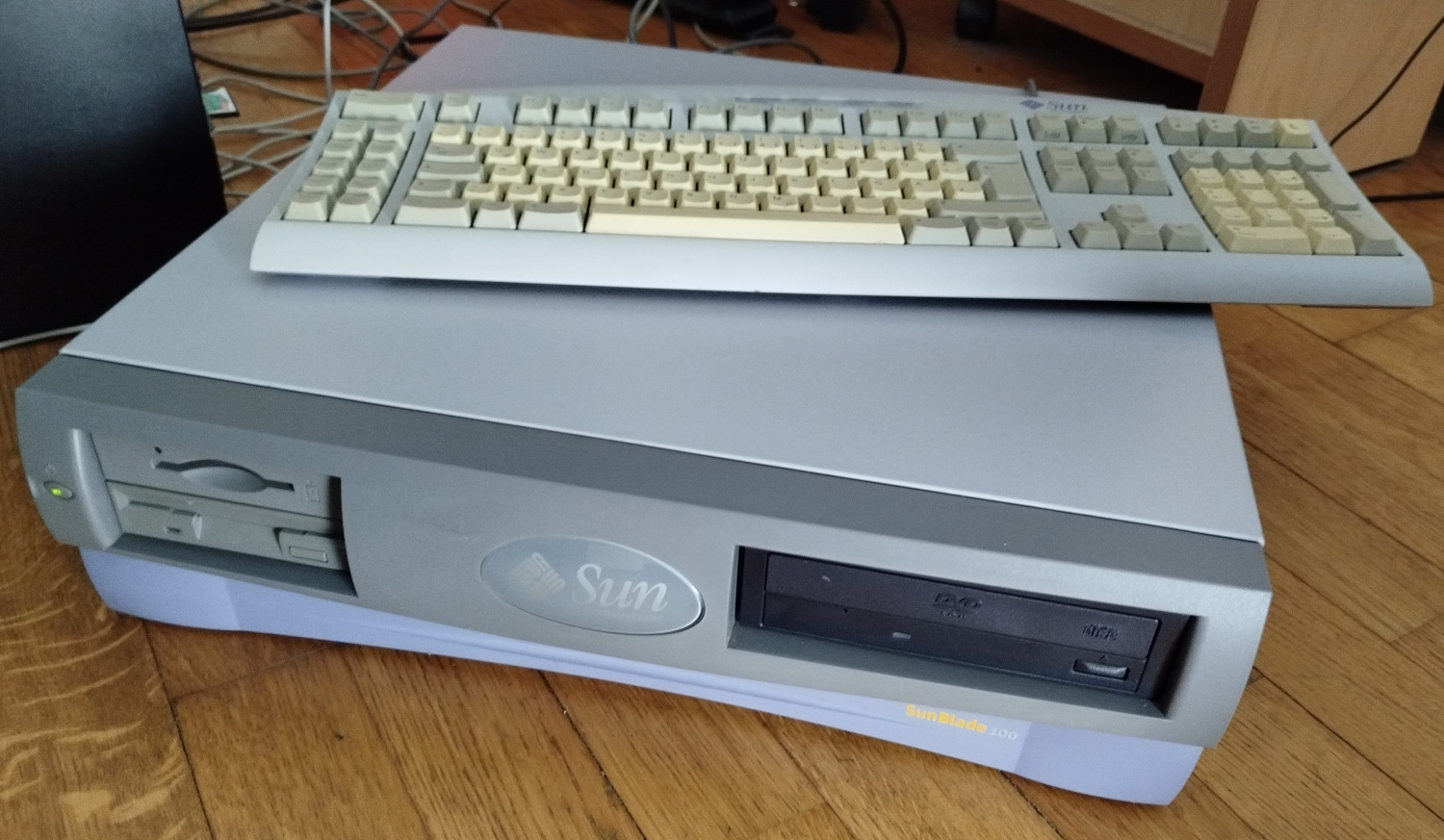
The picture above shows a Sun Blade 100 that I got my hands on. Sun Blade is a series of UltraSPARC based workstations that Sun Microsystems started selling around the turn of the millennium. It apparently has nothing to do with blade servers.
Having grown up with only x86 based PCs (safe for occasionally seeing a PowerPC based Mac), I was eager on the chance to get started playing with SPARC hardware and the software ecosystem around it.
Status:
TODO:
 Back to top Back to top
|
| |
Back to the Index
|